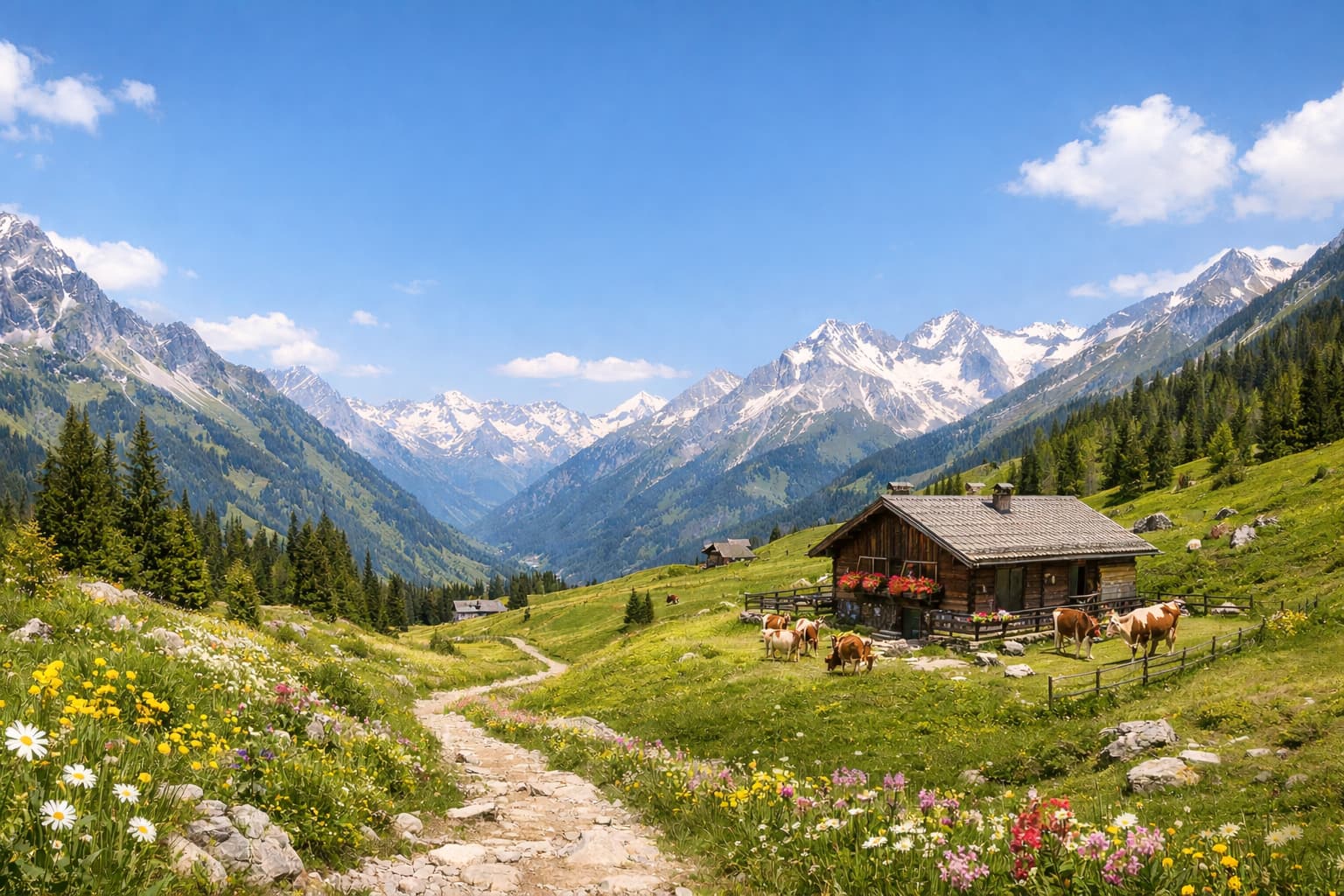
It is a matter of time before a walk is not an ordinary experience anymore. In Austria, that normally strikes when the woods become thin, the dirt path becomes open, and you can hear the clunky sound of the cowbells in the distance. That is when you have hit the Alps in Austria.
The people refer to that season as Almsommer, or the Alpine summer. Snow melts, peasants drag their livestock to the high grazing fields. To hikers, it is an indication that the mountain huts are available. An increase here is not a question of beating the clock; it is a question of having a bite. You replace the noise of the city with the clean mountain air and get a hearty farm-fresh meal. The way of life up here is plain, sincere, and completely in harmony with nature.
Take a stroll around some of the finest pasture hikes that an Austria tour package has to offer.
Vorarlberg: A Journey Through Three Tiers of Farming
Go to Vorarlberg if you desire to see how Alpine farming operates. The locals have been practicing a three-stage farming process for centuries. In the spring, the animals take their departure from the valley farms and go up to the Maiensaess, or middle pastures. At the beginning of the summer, they continue to climb more and more to the uppermost alpine meadows.
The food and land are made by that movement. Vorarlberg has approximately 40 percent of Alpine farms. You will find more than a hundred and fifty-seven cheese-making plants in the mountains.
When climbing the trails in Nenzinger Himmel, you will eventually bump into the Gamperdona alpine restaurant. You must have their local alpine cheese–acidic, fat, and as flavoring herbs that the cows feed on. Along the paths, a great number of huts offer a traditional Alpjause, a wooden board which is loaded with sour cheese, fresh butter, thick slices of homemade bread, and even alpine ice cream. And simply sit on a wooden bench of wood, eat a ton of cheese, and admire the mountains. It’s hard to beat.
Tyrol: Historic Huts and Mobile Dairies at Gampe Thaya
Tyrol is a hiker’s playground. The trails start with simple walks and hikes to serious climbs, yet the reward is always the same: a rest in one of the huts, some of which are more than 500 years old. They provide you with the real preview of a lifestyle that is nearly extinct.
One of the best places to visit in Austria is Gampe Thaya, which is located just above Sölden town. The way there entails a fairly arduous walk in thick woods and open fields. Upon arriving there, you see something strange — Gampe Thaya has a mobile dairy with cheese. The milk of the cows is processed there and then. No transport. The entire process of grass to milk to cheese occurs in the mountains.
Have lunch sitting on their sun terrace, beginning with a plate of local cheese. Leave room for dessert. Gampe Thaya is well known because of the Kaiserschmarrn, which is a shredded, fluffy pancake sprinkled with powdered sugar and a fruit compote. Taking a hot plate and watching the Ötztal Alps will make you forget that your feet are burning.
Salzkammergut: Cable Cars, Blue Lakes, and Sweet Treats
Perhaps you would like the scenery, but not to engage in a tough battle against a steep hill. And there are the Salzkammergut glories. It is located east of Salzburg and is known to be surrounded by glittering lakes and green rolling mountains.
In this case, cheating the altitude is possible. In St. Gilgen, take the Zwolferhorn cable car. It precipitates you way up into Lake Wolfgangsee. From there, just walk. The tracks are good, and most of them are level and fit a leisurely walk.
When you walk through the group of mountains of Osterhorn, you will come across deep trenches, thundering rivers, and sheep. The region is famous for its sweet pastry and the best things to do in Austria. You must not pass a cabin such as the Moosangerl or Gruberalm without trying a Pofesen. It is a common pastry of bread battered, fried in the deep fryer, and stuffed with plum jam. Hearty, restorative, and what you must have had a couple of hours on your legs.
Lower Austria: Scaling Schneeberg and Austria’s Grand Canyon
To be slightly more dramatic, go to Lower Austria. The mountains may be soft, but they may as well be extremely rugged.
The highest point of the region is Schneeberg, which is more than 2 000 meters. It is a strenuous exercise to climb it. The eastern walls are bare and rocky, providing panoramic views towards a distance of Lake Neusiedl, on a clear day. You get to the top, and you find Fischerhutte, the highest mountain hut in Lower Austria. A hot bowl of soup is an actual triumph.
In case you would like deep valleys and fewer mountains, you should go to the Ötscher area. The descent into the Ötscher gorges is the so-called Grand Canyon of Austria, as locals call it. You will go through small ledges of rocks, pass by wild turquoise streams, and great waterfalls. It is completely remote and wild, but you still have time to relax your feet somewhere in the warm welcome of the Ötscherschutzhaus.
Mountain Quirks: Boiling Eggs and Respecting the Locals
There are guidelines and rules of hiking in the Alps, the best places to visit in Austria. The following are some of the things that you must keep in mind before hitting the trails:
- The High-Altitude Egg: And you know, boiling an egg on the mountain takes more time than the usual? As you go up, atmospheric pressure gets lower. At 2,000 meters, the boiling point of water is lower. The innkeepers are aware of when to boil for a soft egg in this place, so better to cling to them for guidance.
- Give Cows Their Space: You will see a lot of cows, and they have a friendly nature. You and cows in frame will make beautiful photos But do not forget, they are not pets. Keep a distance, do not try to pet the calves, and always keep your dog on a short leash.
- Respect the Hustle: Running a hut business on a mountain is difficult. Usually, the innkeepers do all the cleaning, cooking, and farming by themselves. The menus might not have many options, but that is because everything is made fresh and from scratch. Keep cash, be patient, and appreciate the effort it takes to get food onto your plate at that height.
Conclusion
Austria’s alpine pastures offer a perfect blend of physical effort and deep relaxation. It is a place where time slows down. You walk, you breathe, and you eat food made by the very people who tend the land.
Whether you are navigating the ancient farming routes of Vorarlberg, eating fresh cheese at a mobile dairy in Tyrol, cruising along the lakes of Salzkammergut, or conquering the rocky peaks of Lower Austria, the mountains always deliver. You do not need to be a professional climber to enjoy them. You just need a good pair of walking boots, a healthy appetite, and a mood to explore.
So, pack your bag. Cowbells, Huts & Mountains are waiting!