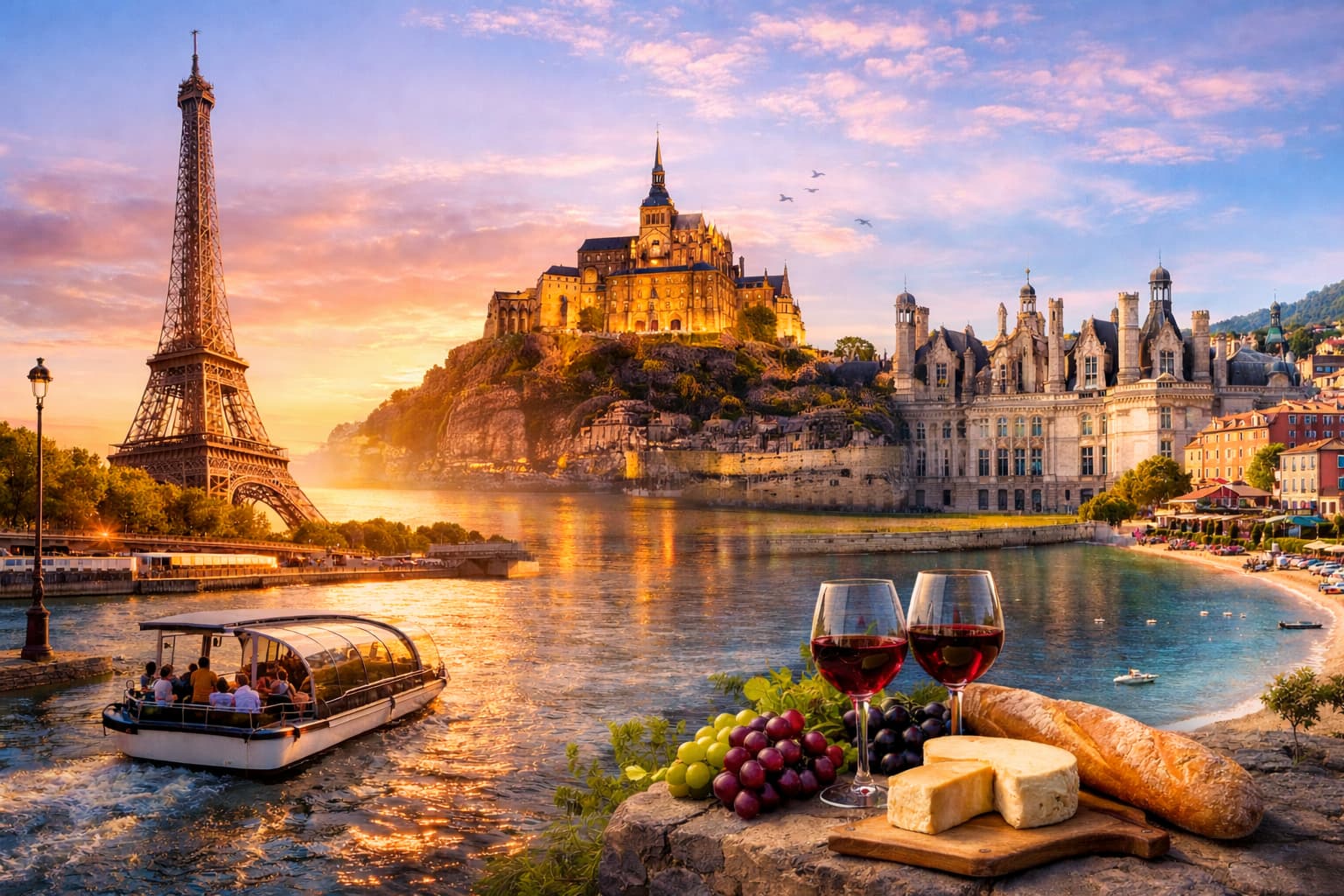
France travel package offers a series of postcards—the Eiffel Tower, a lavender field, maybe a glass of wine in your hand during the sunset. But the moment you arrive there, you realize it’s less about the “big” sights and more about the texture of the day. What is dear to the travellers here are the sound of gravel while walking at a château, the smell of salt on a Brittany breeze, and that unhurried rhythm the French call flâner—the art of wandering without a destination.
The secret to experiencing the best of a France trip package is not trying to see it all. Plan a few corners and stroll at your pace.
Best Places to Visit in France
Here is a guide to the places that stick with you long after the flight home.
1. Normandy: More Than Just History
Most people head to Normandy for the D-Day beaches. And while those sands are deeply moving—especially at places like Juno or Omaha Beach—the region has a lighter, more artistic side that is just as captivating.
- Honfleur’s Harbor: This is where the Impressionists used to hang out, and it’s easy to see why. The light in the harbor bounces off the slate-fronted houses in a way that feels like a live painting. Don’t miss the Maisons Satie, a quirky museum dedicated to composer Erik Satie that is as eccentric as it is musical.
- The Cliffs of Étretat: Imagine giant white chalk arches plunging into the turquoise sea. Walking the cliff-top paths here makes you feel small in the best way possible.
- Mont-St-Michel: Yes, it’s crowded. Yes, it’s a climb. But seeing that abbey rise out of the fog as the tide rushes in? It’s a core memory.
2. The Loire Valley: Living the Fairytale
The Loire Valley is essentially a 170-mile-long garden dotted with more than 300 castles. You don’t need to see them all, but you should see the ones with a “soul.”
- Château de Chenonceau: This is the one that spans the River Cher with graceful arches. It was designed and run almost entirely by women, and you can feel that elegance in the gardens.
- Troglodyte Villages: For something truly unique, visit the Rochemenier Cave Village. People lived in these underground houses for centuries, and exploring them feels like stepping into a secret world.
- Bike the Valley: One of the best ways to get around is by bicycle. The paths are flat, the air is sweet, and you can stop at local vineyards for a tasting whenever the mood strikes.
3. The Dordogne: A Trip Back in Time
If you like storybook villages and prehistoric mysteries, the Dordogne is your spot. It feels older and more rugged than the rest of France.
- Lascaux IV: You can’t go into the original caves (to preserve the art), but the replica at Lascaux IV is mind-blowing. Seeing 20,000-year-old animal paintings in the flickering light reminds you how long humans have been “artsy.”
- Les Eyzies: This riverside village is tucked right into the side of a cliff. It’s home to the National Museum of Prehistory and serves as a great base for exploring the region’s “black gold”—truffles.
4. Provence & The Côte d’Azur: Sun-Drenched Mag
Down south, life slows down even more. The air smells like pine and sea salt, and the colors are dialed up to eleven.
- Roussillon’s Ochre Trails: Forget the lavender for a second and look at the dirt. Roussillon is built on ochre cliffs, creating a landscape of deep oranges and reds that looks like Mars dropped into the middle of France.
- The Calanques of Marseille: These are hidden limestone creeks with water so clear you can see every pebble on the bottom. It requires a bit of a hike to get to spots like Sugiton or Morgiou, but swimming there is the ultimate reward.
- The Art Walk at Château La Coste:Imagine a vineyard where world-class sculptures are scattered among the vines. It’s a workout for your legs and your brain, followed by a very good glass of rosé.
Top Things to Do in France
While the destinations are great, the experiences are what make the trip. Here’s a shortlist of things to actually do while you’re there:
Step Into the Void in Chamonix
If you’re near the Alps, take the gondola up to Aiguille du Midi. There’s a glass box suspended over a 1,000-meter drop. It’s terrifying, exhilarating, and offers the best view of Mont Blanc you’ll ever get.
Surf in Biarritz
The Atlantic coast is wild and wonderful. Biarritz has a 19th-century vibe but some of the best surf breaks in Europe. Even if you don’t surf, watching the sunset from the Côte des Basques is a ritual.
Eat Your Way Through Lyon
Often called the stomach of France, Lyon’s traboules (hidden passageways) and traditional bouchons (small bistros) offer the most authentic food experience in the country.
Climb the Dune du Pilat
Near Bordeaux, you’ll find the tallest sand dune in Europe. It’s 3km long and feels like a desert that accidentally ended up next to a pine forest and the ocean.
Tips for Your First Trip
- Don’t Rush Paris: Most people try to do Paris in two days. Don’t. Give it five. Spend one of those days just sitting in a café in Le Marais or watching the toy sailboats in the Jardin du Luxembourg.
- Learn the “Bonjour” Rule: In France, you don’t start a conversation with “How much is this?” or “Where is the bathroom?” You start with “Bonjour.” It’s the magic key that unlocks French hospitality.
- August is Quiet(er): While the coasts are packed in August, many big cities like Paris or Lyon actually get a bit sleepier as the locals head to the beach. Just check ahead, as some small family-run bistros might be closed for their own holidays.
- The Train is Your Best Friend: The TGV (high-speed train) is incredible. You can get from Paris to Bordeaux or Marseille in a few hours without the stress of an airport.
Final Thoughts
The “best” France tour isn’t the one that checks the most boxes; it’s the one that lets you find your own favorite corner. Whether that’s a quiet bench in a Normandy apple orchard or a bustling wine bar in Bordeaux, the magic of France is found in the gaps between the famous landmarks.
So pack a comfortable pair of shoes, leave a little room in your suitcase for some local honey or a bottle of wine, and remember to look up. The best parts of France aren’t usually on the map.